
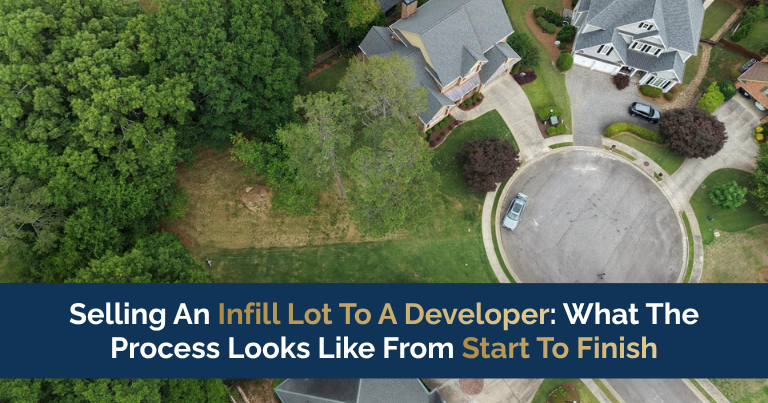
Owning an infill lot in a growing neighborhood presents a unique financial opportunity for your family. These empty parcels located within established communities are incredibly desirable because they connect directly to existing municipal resources. Deciding to sell land to developer groups requires a clear understanding of the acquisition timeline from the very beginning. Knowing exactly what happens at each stage removes anxiety and helps you make deeply informed decisions about your wealth.
An infill lot is a vacant piece of property surrounded by older established development and existing civic infrastructure. Builders actively seek these parcels because they do not have to spend months running new water or sewer lines. This immediate access to utilities significantly reduces construction timelines and lowers overall development costs for the operating sponsor.
When you decide to sell vacant land for development in these established areas, you hold a highly desirable asset. The surrounding neighborhood already has proven property values, which makes securing construction financing much easier for professional builders. This existing stability allows construction firms to confidently present you with stronger and much more reliable purchase offers.
Learning exactly how to maximize land value before selling requires organizing your property documents before contacting a buyer. You can significantly increase your leverage by providing clear boundary surveys and a clean title report upfront. This simple preparation proves you are an educated owner and removes immediate guesswork for the acquiring construction firm.
Taking these administrative steps creates absolute certainty, which is exactly what professional builders need to proceed quickly.
At Apex Investments, our team conducts a thorough site analysis before making any formal purchase offers. We look closely at local zoning classifications, topography, and neighborhood demographic trends to understand what the site can support. This objective evaluation process determines the highest and best use for your specific piece of property.
We share these exact findings openly with landowners to provide a realistic picture of the development journey. Identifying strong residential development opportunities means looking beyond the dirt to see how a new home fits the community. This educational approach ensures you understand the true potential of your land before making any binding commitments.
Consider a family owning a two-acre infill parcel in a mature suburb surrounded by older single-family homes. They initially assume the property is too small for a major builder and consider listing it themselves. However, a professional evaluation reveals the site can comfortably support four modern townhomes due to recent zoning updates.
This discovery completely changes their strategy when they finally decide to sell land to developer professionals in their area. Armed with actual capacity data, they secure an offer based on the value of four future homes rather than one. The family avoids leaving money on the table because they took the time to understand their true property value first.
The transaction officially begins when the builder presents a letter of intent outlining the proposed purchase price and timeline. Once both parties agree on the terms, a formal purchase agreement is signed and the due diligence period begins. During this period, the builder conducts final soil tests, environmental reviews, and secures necessary municipal building permits.
If you choose to sell land to developer groups directly, you avoid the lengthy marketing periods required by traditional sales. Once the municipality approves the construction plans, the closing occurs, and the agreed funds are transferred to your account. This clean and transparent sequence allows you to transition your dormant property into usable capital without unexpected surprises.
Q. What is the first step when I want to sell land to developer groups today?
The first step is organizing your site documentation, including a boundary survey to prove your property is ready for construction.
Q. How do you identify strong residential development opportunities in established neighborhoods?
Professionals analyze existing zoning laws, utility access, and local housing demand to ensure the property supports new residential construction safely.
Q. Why is it easier to sell vacant land for development if it is an infill lot?
Infill lots already have access to public utilities and mature roads, which significantly reduces the construction timeline for the builder.
Q. Where can I find a reliable residential land developer near me?
Look for a local firm that manages construction internally, shares their evaluation process openly, and prioritizes owner education during negotiations.
Q. What is the most effective method regarding how to maximize land value before selling?
Clearing title issues and providing a recent topographical survey are the most effective ways to increase buyer confidence and property value.
Transitioning your property into a successful project requires a trusted partner who values clear communication and rigorous daily discipline. Schedule a site evaluation with Apex Investments to explore your options. Our acquisitions team is fully prepared to analyze your parcel and discuss your goals clearly. Connect with our professionals today to build a strategy that honors your hard work and secures your financial future.
to save your favourite homes and more
Log in with emailDon't have an account? Sign up
Enter your email address and we will send you a link to change your password.
to save your favourite homes and more
Sign up with emailAlready have an account? Log in